Vitol Bunkers and Olam Agri complete world’s first co-processed VLSFO bio-bunkering operation in Singapore
Share article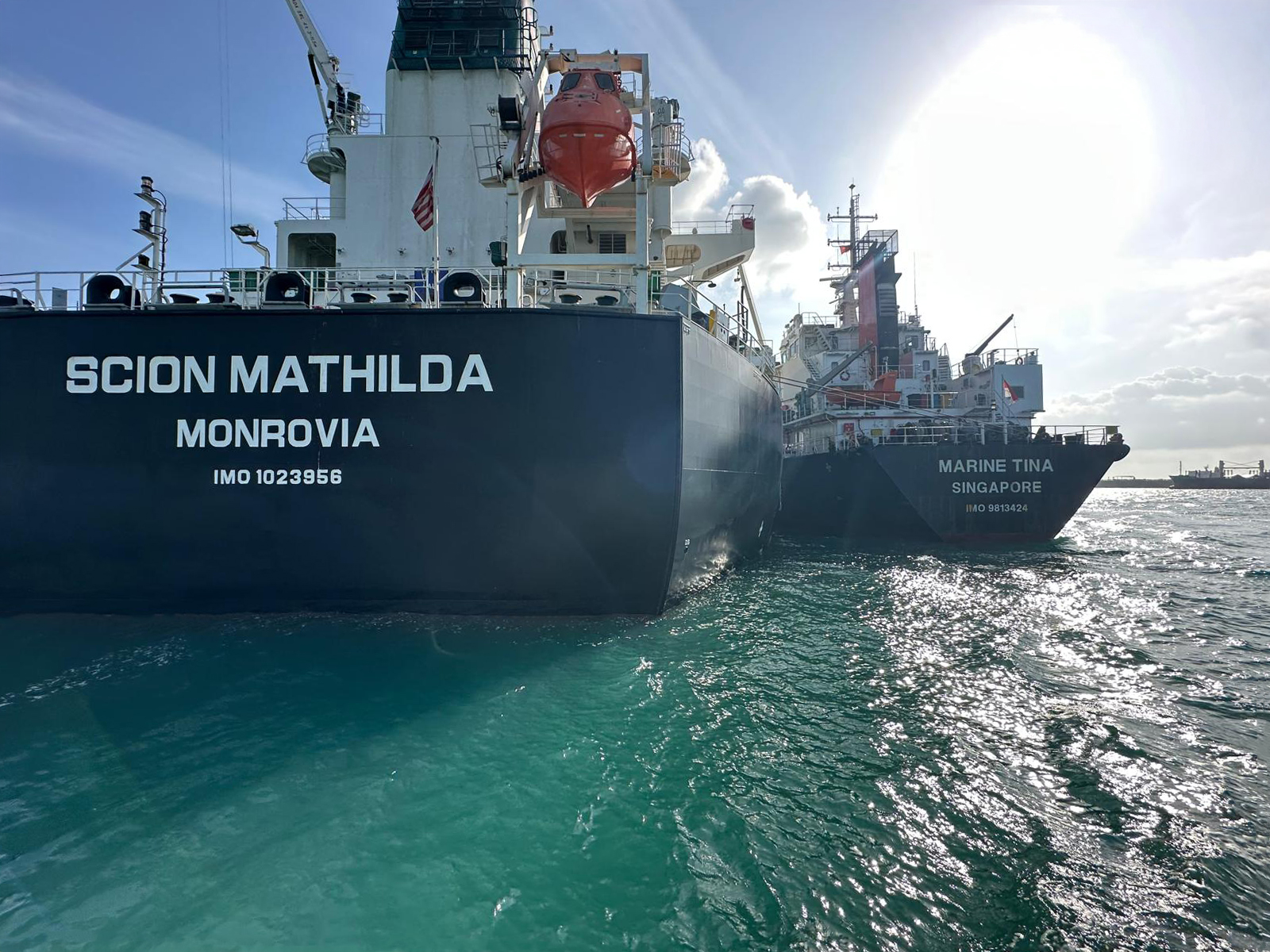
Supplied in Singapore, the lower carbon footprint fuel delivered savings of at least 120 tons CO2eq reduction on the voyage without any added operational requirements
Vitol Bunkers and Olam Agri have successfully completed Singapore’s first bio-bunkering operation using Very Low Sulphur Fuel Oil (VLSFO) co-processed with Cashew Nutshell Liquid (CNSL), showcasing a waste-to-energy approach. The operation marks a significant step forward in the search for practical, scalable alternatives to conventional marine fuels, and demonstrates that meaningful greenhouse gas (GHG) reductions can be achieved without any change to vessel operations.
“The successful deployment of this product, achieving verified greenhouse gas mitigation alongside ensuring operational integrity, serves as a definitive proof of concept. This milestone provides validation to a traditionally risk-averse sector, demonstrating that a previously disregarded bio-product solution can both be operationally viable and sustainable. We thank the owner of the vessel Atlantic Lloyd, the vessel’s technical managers and Vitol for their cooperation and support in executing this trial. We look forward to deepening our collaboration.”
"This operation proves that co-processed VLSFO can be delivered and consumed at sea without any compromise to vessel performance or operational routine. The mass balance solution we have developed opens up a genuinely new avenue for GHG reduction in marine fuels,"
MV Scion Mathilda was supplied with 246.5MT of co-processed VLSFO at the port of Singapore, comprising 212MT of conventional VLSFO and 34.5MT of co-processed CNSL VLSFO. The product was supplied by Vitol Bunkers and procured by Olam Agri’s ocean freight business.
The fuel was subsequently consumed across a voyage: loaded cargo from Caofeidian (China) to Rotterdam (Netherlands), followed by a ballast leg from Rotterdam to Barcarena (Brazil). Total fuel consumption across the voyage comprised 1,354MT of VLSFO, 101MT of MGO and 34.1MT of co-processed VLSFO. The vessel completed the voyage without any operational remarks, confirming the product’s performance in real-world conditions.
GHG performance
The co-processed VLSFO carries a GHG intensity of 2.02 gCO2eq/MJ, delivering savings of at least 120 tons CO2eq compared with conventional VLSFO on an equivalent basis. This outcome was achieved with no additional onboard handling or fuel treatment requirements.
A breakthrough in bio-bunkering technology
Vitol’s co-processing and mass balancing methodology resolves a longstanding challenge in the use of CNSL as a marine biofuel. Direct blending of CNSL has historically been dismissed by the industry due to material compatibility and handling issues. By co-processing CNSL within the refinery stream Vitol has opened a commercially viable pathway for CNSL to contribute to GHG reduction in shipping.
The co-processed VLSFO used in this operation conforms to RMG380 VLSFO grade and has the same chemical composition and quality as conventional fuel, eliminating the need for additional permissions or special clauses in charter party agreements.
Looking ahead
As GHG reduction requirements on the shipping sector intensify toward 2030, competition for sustainable bio-feedstocks with road transport and aviation will increase significantly. CNSL, derived as a by-product of cashew processing, represents an underutilised feedstock with genuine potential as a scalable marine biofuel component. This trial demonstrates that with the right processing approach, it can be integrated into existing supply chains without disruption.